Super Micro Computer’s AI server infrastructure powers global AI adoption. (Illustrative AI-generated image).
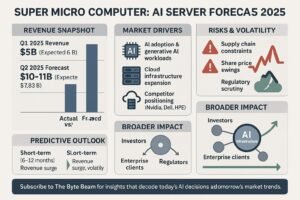
San Jose-based Super Micro Computer (SMCI) has projected Q2 revenue between $10–11 billion, significantly exceeding Wall Street’s $7.83 billion expectation (Reuters). This announcement reflects surging demand for AI-optimized servers as enterprises and cloud providers ramp up machine learning and generative AI workloads. Yet, this optimism contrasts sharply with SMCI’s first-quarter revenue of $5 billion, which fell short of the anticipated $6 billion, causing a post-market share drop of over 9%. The duality highlights the high stakes and volatility in AI infrastructure markets. For investors, tech firms, and policymakers, SMCI’s forecast offers both an opportunity to gauge AI demand trajectories and a cautionary signal about overhyped projections and supply chain fragility.
The headline “Super Micro Computer forecasts upbeat quarterly revenue” conveys growth, but a closer examination reveals layers of complexity. Forecasts of this magnitude are as much strategic signaling as financial guidance. They serve to reassure investors, stabilize market sentiment, and pre-empt competitor narratives in a sector driven by hype and expectations. Yet, SMCI’s first-quarter shortfall reminds us that the market can be unforgiving, punishing even minor deviations from analyst expectations.
Several forces shape this forecast:
-
Investor Pressure & Market Psychology: AI adoption is accelerating, and investors are betting heavily on companies that enable AI workloads. Optimistic forecasts may be aimed at maintaining confidence despite prior misses.
-
Global Supply Chain Dynamics: Semiconductor shortages, shipping delays, and geopolitical constraints (particularly around Taiwan and China, key nodes in chip manufacturing) influence operational realities. These risks are under-reported in mainstream coverage.
-
Competitive Positioning: Nvidia, Dell, HPE, and Lenovo are aggressively targeting the same market. SMCI’s projection could be both a declaration of capability and a pre-emptive signal to retain or gain market share.
Ethically, one must ask whether such aggressive forecasts blur the line between market guidance and aspirational messaging. While optimism can catalyze investor engagement, it may also over-inflate expectations, creating volatility or encouraging short-term speculative trading. Media coverage often simplifies these dynamics, presenting revenue forecasts as straightforward indicators of corporate health rather than complex, multi-factor projections influenced by global trends, technological adoption cycles, and investor psychology.
In essence, SMCI sits at the intersection of innovation, investor perception, and market risk, embodying the duality of the AI hardware boom: immense opportunity shadowed by operational fragility.
- Investors: Gain potential upside from revenue surges but are exposed to volatility.
-
Enterprise Clients: Depend on timely server delivery to power AI projects; shortages or misalignments could disrupt operations.
-
Employees & Supply Chain Partners: Workforce planning and contract negotiations hinge on predictable demand.
-
Regulators: Monitor corporate disclosure practices, supply chain concentration, and AI infrastructure security.
Economic Implications: SMCI’s revenue forecast signals a broader AI infrastructure expansion. Enterprises are investing in high-performance servers for generative AI, machine learning, and data analytics, pushing hardware sales, energy consumption, and operational costs upward. Supply chain resilience and innovation adoption will determine whether growth is sustainable.
Social & Ethical Dimensions: The AI hardware boom impacts employment patterns in IT, data center management, and technical services. It also raises ethical questions: Are companies prioritizing growth over risk management? Are investor expectations fueling short-termism?
Balance of Positives and Negatives:
-
Positive: The forecast may accelerate AI adoption, innovation, and productivity gains across industries.
-
Negative: Over-reliance on optimistic projections can encourage speculative investment, destabilize stock prices, and expose supply chain vulnerabilities.
The takeaway: SMCI’s announcement is a bellwether not only for AI hardware demand but also for corporate communication strategies in high-hype sectors.
Short-term:
-
Revenue could spike if enterprise and cloud adoption aligns with forecasts.
-
Stock volatility is likely to continue, influenced by delivery, supply chain stability, and competitor performance.
-
Analysts may adjust expectations dynamically, creating market over- or under-reactions.
Medium-term:
-
SMCI could solidify its position as a leading AI infrastructure provider if it consistently meets demand.
-
Global AI adoption may accelerate, impacting data center design, energy consumption, and IT labor markets.
-
Competitor responses may lead to consolidation or aggressive price competition.
Potential Structural Changes:
-
Expansion of AI-specific server architecture (tensor cores, optimized GPUs, liquid cooling).
-
Strategic partnerships or M&A to secure chip supply, expand international reach, or integrate vertically.
-
Market behavior may normalize around sustainable growth metrics rather than hyper-optimistic forecasts.
Global Implications:
-
Countries investing heavily in AI infrastructure (U.S., China, EU) may accelerate tech nationalism or export controls to protect strategic supply chains.
-
Investors may use SMCI’s performance as a proxy for AI hardware demand trends globally.
Public Sentiment: Divided. Tech enthusiasts optimistic about AI adoption; cautious investors wary of overblown projections.
Market Reaction: Volatile. Q1 revenue miss and Q2 optimism create swings, reflecting short-term trading behavior.
Regulatory Outlook: Cautious. Disclosure scrutiny and semiconductor trade policies are increasingly relevant.
Media vs Social Discourse: Traditional media emphasizes revenue numbers; social media amplifies both hype and skepticism. Influencers and analysts debate whether AI infrastructure growth is sustainable or speculative, creating polarized narratives that influence investor behavior.
Behavioral analysis suggests that market participants may overreact to short-term misses while underweighting long-term structural growth, a pattern reminiscent of Nvidia’s early AI server adoption cycles (2023–24).
SMCI’s forecast embodies a duality common in tech-driven markets: optimism intertwined with uncertainty. While the AI hardware boom offers transformative potential, companies, investors, and policymakers must navigate operational risks, supply chain constraints, and investor psychology.
Key questions linger:
-
Is the AI server market entering a sustainable growth phase or a speculative bubble?
-
Should corporate optimism justify potential volatility for shareholders?
-
How can regulators balance disclosure transparency with encouragement for innovation?
The broader lesson: AI infrastructure growth is not just a financial story—it is a test of corporate foresight, operational discipline, and ethical communication.
TBBView
“When AI demand fuels optimism, market reality remains the ultimate stress test.”
Comparative Lens
Nvidia’s early AI server cycle (2023–24) illustrates how surging demand can lead to overvaluation and supply-chain pressure, offering a cautionary precedent for SMCI.
Data / Fact Insert
SMCI Q2 revenue forecast: $10–11B vs analyst estimate $7.83B; Q1 revenue: $5B vs $6B expected.
Reader Lens
How would server supply shortages, optimistic forecasts, or AI infrastructure volatility impact your industry, investment strategy, or regional adoption of AI?
What’s Next Byte
Monitor Q2 delivery, competitor strategies, and semiconductor availability to gauge market sustainability.
FAQs
Why is this event important now?
Significance: SMCI’s forecast signals broader AI infrastructure trends and investor expectations.
Who stands to gain or lose?
Impact: Investors could gain from growth or lose from volatility; enterprise clients depend on timely server delivery.
Could this influence other markets?
Global View: High AI server demand affects semiconductor production, supply chains, and international tech policy.
Does this challenge norms or governance models?
Ethics & Policy: Aggressive forecasts highlight the tension between transparent reporting and market signaling.
What lessons can professionals draw?
Reader Relevance: Evaluate risk in AI hardware investments, plan for supply chain contingencies, and critically assess growth narratives.
What signals should we track in coming months?
Future Outlook: Actual Q2 delivery, competitor performance, and chip availability as early indicators of sustainable AI adoption.
Subscribe to The Byte Beam for critical, balanced insights that decode how today’s decisions shape tomorrow’s world.
Disclaimer:
The content provided by The Byte Beam is for informational and editorial purposes only and should not be construed as financial, investment, or legal advice. All analysis, forecasts, and opinions reflect the author’s interpretation of publicly available information at the time of publication. While every effort is made to ensure accuracy, The Byte Beam does not guarantee the completeness or reliability of any data, and readers should conduct their own research or consult a qualified professional before making financial, investment, or business decisions. Past performance is not indicative of future results. The Byte Beam is not responsible for any losses, damages, or decisions arising from reliance on this content.